V-contour or M-contour: anyone who works with press fittings will regularly come across both designations. But what is behind them and which contour is suitable for which application? The answer is more important than it seems at first glance, because an incorrectly selected press contour is one of the most common mistakes on the construction site.

What press contour means and why it is relevant

The press contour describes the profile with which a press connection is made. During pressing, the press jaw or press ring forms the fitting in such a way that a positive, permanent connection is created with the pipe. The profile of the jaw must match the contour of the fitting exactly. If the jaw and fitting do not match, the result is a connection that looks finished but does not achieve the required tightness and strength.

Two contours have established themselves as standard in Europe: the V-contour and the M-contour. Both are widely used in certain regions and by certain system manufacturers. The regional differences have historical reasons and reflect the market penetration of different system manufacturers in individual countries.

V-contour: widely used and tool-flexible

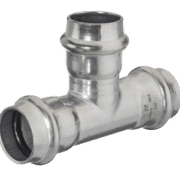
The V-contour is the most commonly used crimping contour in Germany and large parts of Europe. It is supported by most commercially available pressing tools and is compatible with numerous fitting systems. This makes it the preferred choice for companies that work with different pipe materials and media and do not want to have a separate pressing tool for each application.

The AQUAGAS V system from HS Fittings uses the V contour and therefore allows a free choice of tools. This means that companies do not have to replace their existing pressing tool in order to process AQUAGAS V. This is an economically relevant advantage, especially for companies that have already invested in tools.

Get more information now.

M contour: system-bound, but present in the existing building

The M-contour is also widespread, but is more closely linked to specific system manufacturers and their pressing tools. Companies that use M-contour systems require the appropriate tool in each case. This can lead to a bottleneck in existing systems, i.e. when repairing or expanding existing systems, if the original tool is no longer available.

The Flexi-Press system from HS Fittings supports both V- and M-contour up to 28 mm and therefore offers a flexible solution for companies working in mixed stock situations. It is available in E195 steel and 1.4404 stainless steel and therefore covers a wide range of applications. The available seal variants (EPDM, FPM/FKM) enable use in various media.

Warehousing and system selection: What matters

If you consistently standardize your stock to a press contour, you reduce the risk of mix-ups and simplify ordering. Companies that mainly carry out new installations are well advised to rely on the V contour. Companies that do a lot of work in existing buildings may need both contours and benefit from a flexible fitting system. Technical details on all systems can be found in the data sheets and product documentation.

Conclusion: Decide on V-contour or M-contour according to system strategy

The choice between V-contour and M-contour is not just a product question, but an operational strategy. If you are looking for tool flexibility, the V-contour and AQUAGAS V from HS Fittings are the right choice. Those who work with mixed systems will find a practical solution with Flexi-Press. Please contact us for individual advice on the right choice of system.
At first glance, press fittings for gas and water look similar. But the differences are considerable, and they concern precisely the points that are crucial for safe installation: Sealing material, certification and system suitability. If you know the differences, you can avoid confusion and make the right product choice.

Why gas and water have different requirements

Water and gas are physically fundamentally different. Water is incompressible and immediately visible in the event of a leak. Gas, on the other hand, is compressible, invisible and, in the worst case, explosive. This explains why the approval requirements for gas fittings are much stricter than for water fittings. A seal that is suitable for drinking water does not automatically have to be suitable for gas.

In concrete terms, this means that press fittings for gas must have a seal that is permanently resistant to the chemical properties of natural gas and liquid gas and that seals reliably in the event of pressure fluctuations. EPDM seals, which are often used in the drinking water sector, are not suitable for gas.

Sealing material as the most important distinguishing feature

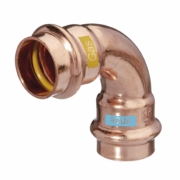
The AQUAGAS-V system from HS Fittings uses HNBR seals (hydrogenated nitrile butadiene rubber). This material is suitable for both gas and water and eliminates the need for separation by medium. This simplifies storage considerably, as there is no need to keep a separate pressfitting line for gas and one for water.

The yellow O-ring is the central identifying feature. It indicates at a glance that this fitting is approved for gas and water. This is an important distinguishing feature on the construction site, especially when different systems and media are installed in parallel.

Get more information now.

Dual certification: what it means in practice

AQUAGAS V is doubly DVGW-certified: for gas in accordance with DVGW worksheet GW392 and for water in accordance with the associated drinking water and heating requirements. This is not a matter of course. Many systems on the market only have one approval. For the installer, dual certification means: one system, one tool, one certificate for two critical media. This saves set-up time, simplifies documentation and increases operational safety.

AQUAGAS V is designed for copper pipes in accordance with DIN EN 1057 in nominal widths of 12 to 54 mm. The associated technical documentation and certificates can be found in the HS Fittings download area.

Labeling and traceability

Documentation of the products used is particularly important for gas pipes. Certified press fittings with clear identification enable seamless traceability during inspections and maintenance work. This facilitates acceptance by the network operator and creates legal certainty for the company carrying out the work.

Conclusion: Press fittings for gas and water with double certification

Press fittings for gas differ from water fittings primarily in terms of the sealing material and the approval. AQUAGAS V from HS Fittings combines both requirements in one system and thus saves storage costs, the risk of confusion and documentation costs. For specific product questions or technical advice, please contact us.

The requirements for materials in drinking water systems are becoming stricter across Europe. For HVAC companies, specialist wholesalers and planners, this means that the choice of materials for fittings and valves is becoming a strategic issue. This article explains the regulatory changes, the consequences for product selection and how you can prepare your company and your customers with good advice.

What has changed in the lead limit

The EU Drinking Water Directive 2020/2184, which has been transposed into German law, has lowered the limit value for lead in drinking water to 5 micrograms per liter, significantly stricter than the previous value of 10 micrograms. This not only brings old lead pipes into focus, but also taps and fittings that could release lead during operation. Products that were previously considered inconspicuous may suddenly become relevant under the new limit values.

For HVAC companies, this means that only materials that demonstrably meet the new requirements are permitted for new installations, renovations and extensions to drinking water pipes. Those who are not up to date here risk liability problems during acceptance.

Malleable cast iron and the question of lead content

Malleable cast iron is an iron material. Due to its design, it does not contain any lead in the alloy, which distinguishes it from lead-containing brass alloys in this respect. For drinking water installations, this is a factual argument that is becoming increasingly relevant in planning discussions and tenders.

HS Fittings offers DVGW-certified malleable cast iron fittings that are approved for drinking water applications. The certification also includes hygienic safety for the intended use. Details can be found in the associated data sheets and certificate documents.

Get more information now.

Stock rotation and stock maintenance in specialist wholesaling

In addition to product selection, the question of stock rotation also arises for specialist wholesalers. Products that were still manufactured on the basis of older material standards or alloy formulations may no longer be legally suitable for new installation in drinking water systems without restriction. It is therefore advisable to carry out a targeted inventory and streamline the product range.

At the same time, this process is an opportunity: those who have switched to future-proof products early on can use this as a sales argument. Craft businesses are increasingly looking for suppliers who take the product selection for drinking water hygiene requirements off their hands and offer certified product ranges.

Press fittings for drinking water: seals and system selection

The question of material also plays a role with press fittings. The AQUAGAS-V press fitting system from HS Fittings is designed for copper pipes in accordance with DIN EN 1057 and is DVGW-certified for drinking water. The HNBR seals used are suitable for contact with drinking water and gas. The dual certification for gas and water simplifies storage and makes the system an economically interesting option for companies with mixed requirements.

Conclusion: Using lead-free drinking water installations as a quality feature

Switching to lead-free materials in drinking water systems is not only a regulatory obligation, but also a quality feature that HVAC companies and wholesalers can actively communicate. With its malleable cast iron and pressfitting products, HS Fittings offers certified solutions for future-proof drinking water installations. If you have any questions about product selection or certificates, please do not hesitate to contact us.

Drinking water, heating and gas, three media, three requirement profiles. Anyone planning or installing pipelines needs to know the differences, because the wrong pipe connection system in the wrong medium can have serious consequences. This article provides clear guidance on which system fits where and what to look out for when choosing a system.

Drinking water: focus on hygiene and material compatibility

Special requirements apply to drinking water pipes. The material must be suitable for drinking water, must not release any substances that are harmful to health and must remain permanently tight. Seals in press fittings must be suitable for permanent contact with drinking water. EPDM seals are widely used in the drinking water sector because they are resistant to drinking water and many other aqueous media.

Threaded fittings made of malleable cast iron with DVGW certification, such as those offered by HS Fittings, are approved for drinking water applications. The increasingly stringent requirements for lead-free materials must be observed. In contrast to certain brass alloys, malleable cast iron does not contain any lead, which positions it well for these requirements.

Heating: Pressure stability and temperature resistance

Heating systems operate at elevated temperatures and system pressures. Fittings and seals must be permanently pressure-tight and temperature-resistant. EPDM seals, which are suitable for heating systems up to the typical system temperatures, are often used in the pressing area.

The AQUAGAS-V system from HS Fittings is expressly designed for heating systems and is DVGW-certified accordingly. The following applies to threaded fittings: Malleable cast iron fittings in accordance with DIN EN 10242 are designed for heating temperatures and system pressures in normal building areas.

Get more information now.

Gas: certification and seal selection are non-negotiable

The strictest requirements apply to gas installations. A leak is not just damage, it is a safety risk. This means that only products with explicit gas approval may be installed in gas pipes. General pressure resistance is not sufficient.

Press fittings in gas installations require special seals that are also permanently resistant to natural gas and liquid gas. HNBR seals, such as those used in the AQUAGAS-V system, are suitable for gas. The yellow O-ring serves as a practical identification feature for gas suitability.

Malleable cast iron fittings with DVGW certification for gas are also a proven choice and are used in many gas installations in buildings. You can find the relevant technical details in the data sheets and downloads.

System selection according to medium and situation

There is no single system for all three media, but dual certification makes storage planning easier. AQUAGAS V is dual DVGW-certified for drinking water, heating and gas. This reduces the number of variants in stock and simplifies ordering for projects with mixed requirements. Malleable cast iron fittings are also available in DVGW-certified versions for several media.

Conclusion: Select pipe connection systems correctly according to medium

Choosing the right pipe connection system is not just a question of price, but of safety and quality. Drinking water, heating and gas place different demands on materials, seals and certification. HS Fittings offers tested and certified solutions for all three areas. Please contact us for a specific product recommendation for your project.

Press fittings are considered a safe and fast connection technology. However, even with this system, there are sources of error that repeatedly lead to problems in practice. If you know the most common mistakes, you can avoid them and take full advantage of the benefits of press technology. This article shows where experience has shown things to go wrong on the construction site.

Incorrect tool or incorrect pressing contour

Press fittings are system-specific. This means that not every pressing tool is suitable for every fitting. The pressing contour, i.e. the profile of the pressing jaw or pressing ring, must match the contour of the fitting. The two most common contours on the European market are the V-contour and the M-contour. A V-contour jaw on an M-contour fitting or vice versa creates a connection that looks tight but is not.

The AQUAGAS V system from HS Fittings uses the V contour. It is compatible with most commercially available pressing tools from common manufacturers, which facilitates the free choice of tools on the construction site. Nevertheless, always check tool compatibility before processing and refer to the system documentation if in doubt.

O-ring problems: fit, condition and confusion

The tightness of a press connection depends crucially on the O-ring. Errors can occur in several ways: The O-ring is not correctly positioned in the groove. It is installed twisted or crushed. It has been damaged by improper storage or UV exposure. Or it has been combined with the wrong O-ring type for the respective medium.

With AQUAGAS V, the yellow HNBR O-ring indicates suitability for gas and water. This color coding is no coincidence, but a practical distinguishing feature. Anyone who has different pressing systems on site should pay attention to the O-ring color and avoid confusion by clearly separating the bearings.

Get more information now.

Unpressed connections overlooked

One of the most common and most dangerous mistakes on the construction site: a connection is plugged in but inadvertently not crimped. At a cursory glance, it looks finished. The leak only becomes apparent during the pressure test or, worse still, after commissioning.

The principle of “unpressed and leaking” (UVUD), which applies to the AQUAGAS-V system, addresses precisely this risk. An inserted but unpressed AQUAGAS-V connection is designed in such a way that it leaks during the pressure test. This makes forgotten connections visible before the system goes into operation. This is an important safety function for HVAC companies, which prevents complaints and consequential damage.

Pipe end not properly prepared

The pipe quality also influences the reliability of the connection. Burrs, ovality due to unclean cutting or a pipe end that has not been deburred can lead to the O-ring being damaged or the connection not sitting flat. Copper pipes in accordance with DIN EN 1057 should be cut at right angles, deburred and calibrated before the fitting is fitted. You can find more information on the processing instructions in the technical documents in the download area.

Conclusion: Pressfitting errors are avoidable

Most faults in press fittings are not caused by poor products, but by carelessness in tool selection, O-ring handling and pipe preparation. If you consistently keep these points in mind, you will benefit from fast, reliable and durable connection technology. If you have any questions about processing, system compatibility or product details , please contact us. We will be happy to support you.

You come across DVGW certification all the time in the HVAC sector: on product packaging, in data sheets and in tender texts. But what does this certification actually mean? What are the requirements behind it and why is it really relevant for installers, planners and purchasers? This article provides clarity without a jungle of paragraphs.

What the DVGW is and what it stands for

The DVGW, the German Technical and Scientific Association for Gas and Water, is a technical and scientific organization that develops regulations for gas and water supply in Germany. Its worksheets, testing principles and certification programs are regarded as recognized rules of technology. This means that anyone who plans and installs in accordance with DVGW requirements is on legally secure ground, as compliance with recognized codes of practice is a central duty of care in the installation trade in Germany.

What DVGW certification means for a fitting

A fitting bearing the DVGW test mark has undergone an independent test procedure. Among other things, dimensional accuracy, material composition, pressure resistance, tightness and media compatibility are tested. Depending on the area of application, i.e. gas or water, different test principles and limit values apply.

For malleable cast iron fittings from HS Fittings, this means that certification in accordance with DVGW and also SVGW, the Swiss equivalent, proves that these fittings are approved for gas and drinking water installations in both countries. This is not a matter of course, as many manufacturers only have one of the two certifications.

Get more information now.

Practical relevance for HVAC companies and planners

In practice, DVGW certification provides protection on several levels. Firstly, under insurance law. In the event of damage caused by a leaking or faulty installation, the product quality used can become an issue. Certified products considerably strengthen the position of the installer. Secondly: In public tenders. Many clients explicitly demand DVGW-certified materials, especially for drinking water and gas installations in public buildings. Thirdly: During acceptance and testing. Experts and authorities accept certified products without any further obligation to provide evidence, whereas non-certified products can trigger inquiries.

DVGW certification and drinking water hygiene

In the drinking water sector, certification is becoming even more important as the European Drinking Water Directive further harmonizes and tightens the requirements for materials in contact with drinking water. Products that are already certified according to demanding DVGW test standards are a good starting point for this development. The relevant certificates and data sheets can be found in the HS Fittings download area.

Conclusion: DVGW certification creates safety for everyone involved

DVGW certification is not a bureaucratic accessory, but a tangible quality feature with legal and practical significance. For fabricators, planners and purchasers, it means less risk, more legal certainty and a stronger position in the event of acceptance tests and claims. HS Fittings offers DVGW and SVGW-certified fittings for gas and drinking water. If you have any questions about certificates or product details, please contact us.

Anyone connecting pipes today has the choice between different joining methods. Threaded fittings and press fittings are often in direct competition with each other. Both systems fulfill their task, but they do so in different ways and with different economic costs. This article shows which solution is actually more economical in which situation.

Threaded fittings: proven technology with clear strengths

The threaded fitting has been in use for generations. The connection technology is simple, robust and requires no special tools. A pipe cutter, a thread cutter and sealing material are all that is needed for installation. This is a considerable advantage for plumbing companies working with existing installations: the parts are available everywhere, the installation is familiar and the apprentice can join in after a short briefing.

Threaded fittings made of malleable cast iron in accordance with DIN EN 10242 are also mechanically very resilient and can be installed even in difficult spaces because no pressing machine needs to be moved. For warehousing, this means less capital tied up in tool stock.

Press fittings: speed and secure connection

Press fittings create a form-fit connection in seconds. Pressing with the electric pressing tool is fast, reproducible and, if carried out correctly, tight. For new build installations with many similar connection points and long straight pipe sections, this is a real time saver.

The AQUAGAS-V system from HS Fittings, for example, is designed for copper pipes in accordance with DIN EN 1057, is double DVGW-certified for drinking water, heating and gas and uses the V-contour, which can be processed with numerous commercially available pressing tools. The “unpressed and leaking” safety feature reliably indicates unpressed connections before the pressure test.

Get more information now.

The economic comparison in practice

In a direct cost comparison, press fittings are often initially more expensive in terms of material. However, this changes when you consider the entire assembly process. Press fittings are quicker to prepare, and connections can be made in half the time under favorable conditions. For large projects with high volumes, this time advantage outweighs the higher material costs.

Threaded fittings, on the other hand, are more economical when it comes to individual connections, when working in existing buildings or when the pipe system makes subsequent conversions likely. Threads can be loosened and resealed. A crimped connection is permanent and cannot be loosened.

Susceptibility to errors and installation safety

Threaded connections are prone to errors if the thread is not cut cleanly or the sealing material is applied incorrectly. Leaks due to insufficient hemp or incorrect PTFE tape are a well-known problem. Press fittings do not have this risk, but they do have another risk: forgotten or incorrectly executed pressing. The “unpressed and leaking” safety principle of AQUAGAS V addresses precisely this risk and makes it visible during the pressure test.

Conclusion: Decide on threaded fittings or press fittings depending on the application

Neither threaded fittings nor press fittings are the better choice across the board. The decision depends on project size, stock situation, tool availability and installation conditions. HS Fittings offers both systems in proven quality. We will be happy to discuss which solution is right for your project. Get in touch and tell us about your requirements.

Malleable cast iron fittings have been part of the basic equipment of professional pipe installations for decades. Anyone planning, installing or purchasing in the HVAC sector can hardly avoid this material. And yet knowledge about properties, standards and application limits is often incomplete. This article explains what malleable cast iron fittings are, where they show their strengths and what to look out for when selecting them.

What is malleable cast iron and how does it differ from other materials?

Malleable cast iron is an iron material that is produced from white pig iron using a special heat treatment process. The result is a material with high toughness, good machinability and excellent compressive strength. Compared to gray cast iron, malleable cast iron is significantly less brittle and can be machined cleanly with taps. Compared to brass, it offers a more favorable price-performance ratio for certain applications and a higher mechanical load capacity for large nominal widths.

Fittings made from this material are usually manufactured with external threads in accordance with DIN EN 10242. This standard defines the dimensions, the thread design and the pressure levels for which the fittings are tested. For the user, this means that malleable cast iron fittings from different manufacturers are interchangeable in accordance with the standard, provided they are based on the same thread standard.

Galvanizing as corrosion protection: Why the layer thickness is crucial

Malleable cast iron fittings are hot-dip galvanized as standard. The zinc coating protects the iron material from corrosion and significantly extends its service life. The coating thickness is crucial here: the standard defines minimum values, but not all products on the market meet these with the same effort.

HS Fittings uses a galvanized layer on its galvanized malleable cast iron fittings that is significantly higher than the standard specifications. This increases resistance to moisture and aggressive environmental conditions and makes these fittings particularly suitable for industrial applications and underground installations where there is increased corrosion pressure.

Get more information now.

Areas of application in practice

Malleable cast iron fittings are primarily approved for gas-carrying and water-carrying pipes in building installations. Typical areas of application are heating systems, cold and hot water pipes and gas installations up to the permitted pressure levels. They are also widely used in industry, for example in compressed air lines or pipe network connections.

The connection technology with threaded connection in accordance with DIN EN 10242 is tried and tested, widely used and requires no special tools. This makes malleable cast iron fittings particularly attractive for existing installations and for installations where flexibility in the choice of tools is important. Installation can be carried out quickly and easily by trained HVAC specialists.

DVGW and SVGW certification as a sign of quality

For use in gas and drinking water installations, certification in accordance with DVGW (German Technical and Scientific Association for Gas and Water) and SVGW (Swiss Technical and Scientific Association for Gas and Water) is a relevant proof of quality. HS Fittings malleable cast iron fittings meet these requirements and are certified accordingly. This gives planners, processors and operators the necessary legal certainty for drinking water and gas systems.

What to look out for when choosing

Not every connection is equally suitable for every application. Anyone selecting malleable cast iron fittings should keep the following points in mind:

  • Check the pressure rating and temperature range of the application
  • Match the nominal diameter and thread design to the pipe system
  • Clarify certification requirements for the area of application (gas, drinking water, industry)
  • Request galvanizing quality in case of corrosion risk

For specialist wholesalers and HVAC companies, this means that a supplier who delivers both standard-compliant and above-average galvanized malleable cast iron fittings with DVGW certification reduces the risk of complaints and simplifies product selection. You can find more technical details in the data sheets and downloads.

Conclusion: Malleable cast iron fittings as a reliable basis for threaded installations

Malleable cast iron fittings impress with their conformity to standards, mechanical robustness and proven connection technology. With a strong galvanized coating and DVGW/SVGW certification, HS Fittings products are well equipped for a wide range of applications in heating, water and gas. If you want to make the right choice for your project, HS Fittings will provide you with professional support and the right product range. Feel free to contact us and let us advise you.